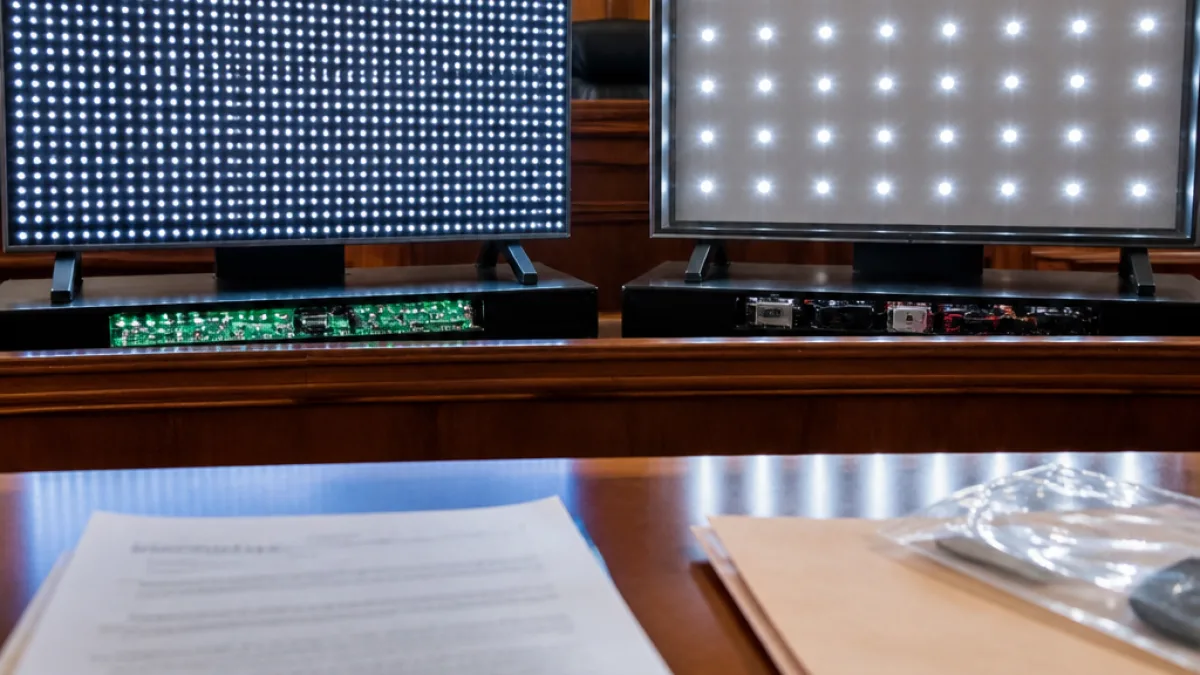
TCL has filed a lawsuit against Samsung in the U.S. District Court for the Central District of California, alleging that Samsung marketed some conventional LED televisions as Mini LED products. The complaint claims that the disputed sets were reworked members of Samsung’s Crystal UHD line and did not use full-array local dimming, a technology TCL says is central to the Mini LED designation.
The case places a commercially important display term at the center of a legal dispute. Mini LED televisions have become a major part of the large-screen market, including models positioned below flagship OLED products. For manufacturers, distributors and custom dealers, the terminology affects how products are presented, compared and specified. TCL’s allegations have not been adjudicated, and the court will determine whether Samsung violated California’s Unfair Competition Law.
“defrauding the market”
TCL used that phrase in describing Samsung’s alleged conduct, according to the lawsuit as reported by SlashGear. The complaint further alleges that Samsung introduced what TCL calls “sham products” to compete with TCL’s lower-priced Mini LED range after Samsung’s market position was affected by its lack of a competing product at that price level. TCL is seeking relief for the alleged commercial harm.
What TCL says qualifies as Mini LED
According to TCL’s position in the case, a Mini LED television should use multiple independently controlled Mini LEDs that can brighten or dim in response to the image. The company links that architecture to full-array local dimming, commonly abbreviated as FALD. That distinction separates the backlight structure described in TCL’s complaint from a conventional LED set that may use the Mini LED name without the same independently controlled lighting arrangement.
- Allegation: Samsung rebranded regular LED televisions as Mini LED models.
- Technology at issue: independently controlled Mini LEDs and full-array local dimming.
- Legal venue: U.S. District Court for the Central District of California.
- Claim identified: violation of California’s Unfair Competition Law.
The dispute also highlights the limits of relying on a product label alone when evaluating a display for a project. The lawsuit distinguishes between the Mini LED name and the underlying backlight design, including whether a television has independently controlled dimming. Those details can affect product comparisons in showroom demonstrations, dealer specifications and proposals for dedicated viewing spaces.
A dispute over market positioning
TCL alleges that its affordable full-array Mini LED televisions had performed strongly in the United States and that the disputed Samsung models took market share from that range. The complaint says Samsung priced the affected M Models below TCL’s least expensive Mini LED televisions after failing to develop a viable competing product at that price point. These are TCL’s claims in litigation, rather than findings by the court.
Samsung’s alleged use of the label, the technical characteristics of the televisions and the competitive consequences will be considered as the case proceeds. The dispute gives manufacturers and channel partners a clear legal reason to distinguish between a display’s marketing description and its published backlight architecture when communicating product capabilities.