Active loudspeaker systems are receiving greater attention from audio manufacturers as integrated amplification and digital processing give designers more control over the signal path. Engineering reports published by the Japan Audio Society, which oversees Hi-Res Audio certification, highlight work by KEF, Yamaha and Avantgarde Acoustic as the sector challenges the long-established preference for passive speakers paired with separate amplifiers.
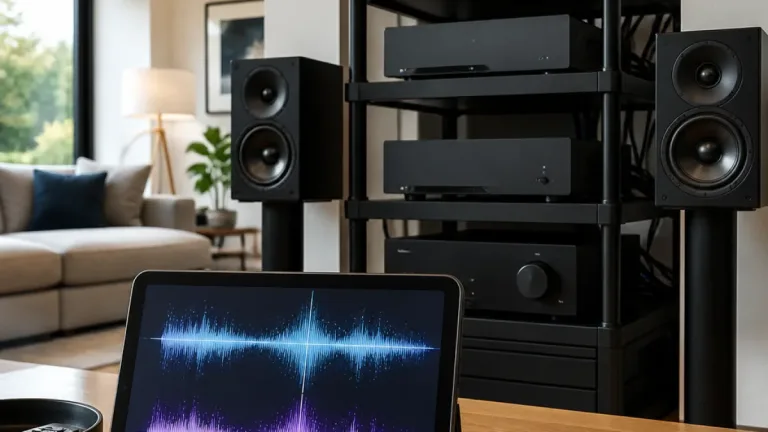
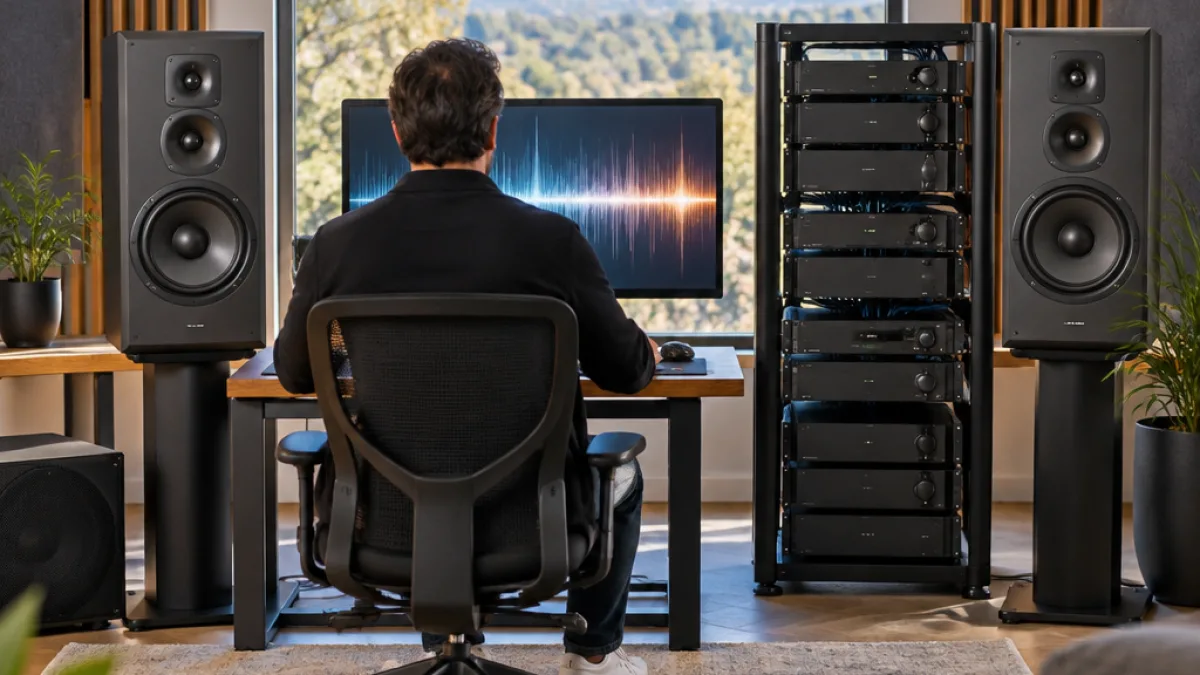
In a passive arrangement, an external amplifier drives a speaker whose crossover divides the signal between its drivers. A fully active design performs that division before amplification, allowing separate amplifier channels to be matched directly to individual drivers. That architecture can reduce interactions between low- and high-frequency sections while giving the manufacturer more control over the behavior of the complete speaker system.
Amplification and processing move inside the speaker
The engineering case for active systems extends beyond the removal of an external amplifier. Manufacturers can select different amplification technologies for different parts of the frequency range, while digital signal processing can be used to adjust frequency response, driver timing, phase alignment and crossover behavior. Those functions are set during the design of the speaker rather than left entirely to the installer or end user through a collection of separate components.
KEF Chief Technology Officer Jack Oclee-Brown described the potential of the approach in terms of both performance and system design:
“From a technical perspective, active speakers have huge advantages, which allow us to make active speaker systems that can outperform a traditional hi-fi system of the same total price,” said KEF Chief Technology Officer Jack Oclee-Brown.
For custom audio dealers and integrators, the distinction is important because an active loudspeaker is engineered as a more tightly integrated system. The amplification, crossover behavior and processing are considered together by the manufacturer. That can change how a system is specified, compared and installed, particularly where the design goal is to reduce the number of separate electronics while retaining control over the loudspeaker’s response.
KEF applies sensing and correction to the low-frequency driver
KEF’s recently launched LS LUXE speakers illustrate one implementation of the concept. The model combines current-drive amplification with the company’s Velocity Control Technology, or VECO. According to the engineering description, an internal sensing coil monitors the movement of the low- and mid-frequency driver and sends feedback to the amplifier.
The amplifier uses that information to correct unwanted driver motion, with the stated objective of reducing distortion. The arrangement places monitoring, amplification and correction within the loudspeaker rather than treating the speaker and amplifier as independent products. For an installer, that means the relevant system characteristics are tied to the manufacturer’s complete design rather than to a separately selected amplifier and passive crossover.
| Company or organization | Development described | Technical emphasis |
|---|---|---|
| Japan Audio Society | Engineering reports on active loudspeaker development | Integrated amplification and acoustic performance |
| KEF | LS LUXE | Current-drive amplification and VECO sensing |
| Yamaha | Active speaker development | Integrated amplification |
| Avantgarde Acoustic | Active speaker development | Integrated amplification |
The move toward active designs is taking place alongside stronger demand for simpler home audio systems and continued growth in music streaming. Manufacturers are therefore positioning active speakers not only as a convenience option, but also as a way to preserve control over sound reproduction while reducing the number of separate components in a system.
Passive speakers remain important to the traditional hi-fi model because they allow users to choose, replace and upgrade amplifiers independently. Active systems take a different approach: the speaker, amplifier, crossover and processing are developed as a unified product. That difference will remain central when dealers and integrators assess system flexibility against the benefits of manufacturer-managed signal processing and amplification.