The Federal Communications Commission (FCC) has identified apparent broadcast-power compliance problems in several TP-Link Wi-Fi 7 routers, according to letters sent to the company on October 15, 2026. The findings concern equipment authorization parameters used for devices sold in the United States and involve samples obtained through retail channels.
The FCC’s Office of Engineering and Technology (OET) said it had “tentatively determined that TP-Link included false or incorrect information in its applications for these equipment authorizations; and these devices do not operate consistently with the parameters power levels submitted in the certification applications.” The wording describes a preliminary determination rather than a final enforcement conclusion.
Measurements identified by the FCC
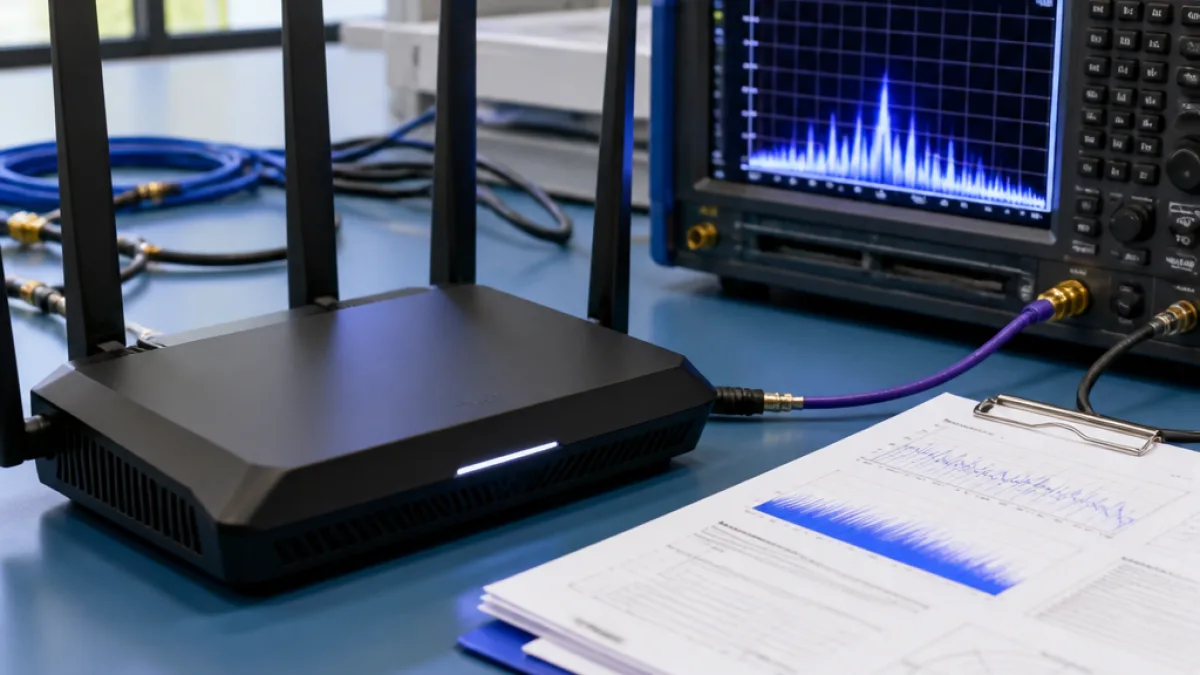
The reported results relate to power spectral density equivalent isotropically radiated power, or PSD EIRP, a measurement used to describe wireless transmission power. The limits vary by frequency band, including the 2.4GHz, 5GHz and 6GHz bands. The FCC’s finding involving the Archer GE800 is the most detailed example in the letters described by Dong Knows Tech.
| Model | Reported FCC finding |
|---|---|
| Archer GE800 | Exceeded the 5 dBm/MHz FCC PSD EIRP limit by 3.28 dB and the certified value of 4.89 dBm/MHz by 3.39 dB |
| Archer BE670 | Exceeded the limit by 2.2 dB on the 6GHz band |
| Deco BE67 | Exceeded the limit by 4.11 dB |
For the Archer GE800, the measured result was approximately 2.18 times the certified power level, according to the FCC information reported by Dong Knows Tech. The publication described the Archer GE800 as a flagship gaming router and said the model was one of several TP-Link Wi-Fi 7 products covered by the agency’s findings.
Why the certification data matters
Equipment authorization establishes the operating parameters under which a wireless device can be marketed in the United States. A router that operates above the power levels submitted for certification is therefore not being evaluated only on its advertised Wi-Fi capabilities; the discrepancy also concerns whether its radio operation matches the conditions approved by the regulator.
The OET said its findings came from samples acquired through retail channels, rather than samples submitted by TP-Link for the original applications. That distinction is material for installers and integrators managing standardized equipment estates: the measurements relate to units obtained in the market and not solely to documentation supplied during the authorization process.
- The FCC reported apparent discrepancies between certified and measured power levels.
- The reported products include the Archer GE800, Archer BE670 and Deco BE67.
- The Archer GE800 was reported to exceed the applicable limit by 3.28 dB.
The information reported by Dong Knows Tech does not establish a final disposition for the affected models. The FCC letters described a tentative determination, while the published findings identify the measured deviations and the certification information under review. Any subsequent regulatory action, remediation or product status would depend on further proceedings and communications involving the FCC and TP-Link.