
Wi-Fi 8 is being developed around a different priority from the recent push toward higher peak bandwidth: making wireless connections more consistent in difficult conditions. The standard, known as 802.11bn, is still in development, and final approval is expected in 2028.
Engadget reports that Wi-Fi 7 can reach a theoretical maximum of about 23 Gbps, a figure that is rarely approached in normal household use. Wi-Fi 7 was released in 2024 and can support faster services, including a 2 Gbps fiber connection, particularly when a client device is near the router. However, the generation has also been associated with stability problems, limited wall penetration and relatively short range.
Reliability becomes the main target
Wi-Fi 8 is intended to address the conditions that create inconsistent service across a home. Those include weak coverage in one area of a property, heavy competition for airtime in an apartment building and interruptions when a client moves between rooms and changes access points.
The draft standard’s working nickname, “Ultra High Reliability,” reflects that emphasis.
According to the reported targets, Wi-Fi 8 is designed to deliver 25% better throughput when signals are weak, 25% fewer dropped packets, especially during movement between access points, and 25% lower latency during the least stable conditions. These are development targets for the standard rather than results presented from a completed certification program.
| Wi-Fi 8 focus | Reported target or feature |
|---|---|
| Weak-signal performance | 25% better throughput |
| Connection continuity | 25% fewer dropped packets |
| Latency in unstable conditions | 25% lower latency |
| Access-point behavior | Coordinated transmission between compatible access points |
Coordination could matter most in mesh systems
A central change involves how multiple access points share wireless capacity. Current routers generally take turns using a channel, but that process is not always efficient when several networks or mesh nodes are active. Wi-Fi 8 is being designed to allow compatible access points to coordinate their transmissions.
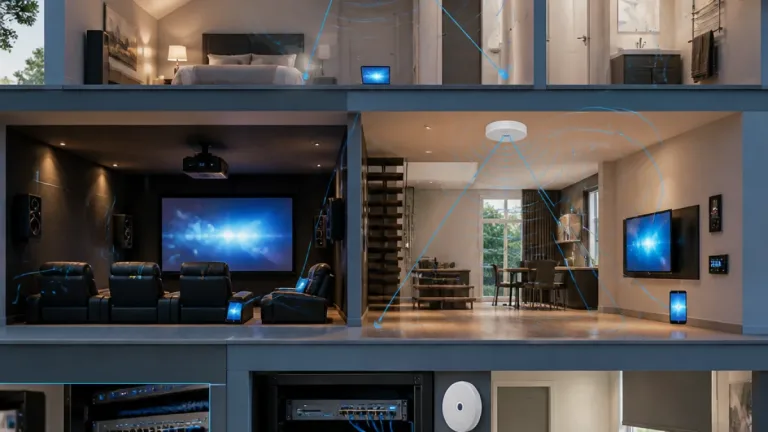
That approach is particularly relevant to professionally planned mesh networks, where the objective is not simply to add coverage nodes but to maintain service as users and devices move through a property. The reported use cases also include dense residential environments where around 20 networks may be competing for airtime.
- Wi-Fi 8 is aimed at consistency rather than a straightforward increase in peak speed.
- Its proposed improvements focus on weak signals, packet loss, latency and handoffs between access points.
- Coordinated transmission could be especially relevant to mesh deployments.
Early hardware uses a draft specification
ASUS already sells a gaming router and a mesh system based on Wi-Fi 8, while a TP-Link model is expected in some regions. Those products are based on the draft specification, so their support for the eventual standard cannot be assumed to cover every final feature.
For the planned improvements to appear in a network, both sides of the connection will need to support Wi-Fi 8: the access point or router and the connected client, such as a phone, laptop or tablet. That requirement limits the immediate benefit of early hardware and makes draft-based equipment a future-facing purchase rather than a guaranteed short-term performance upgrade.
Engadget notes that many home internet plans provide only a few hundred megabits per second, speeds that older Wi-Fi 6 routers can generally handle. In those installations, coverage, placement and roaming behavior may remain more important than the headline capacity of a newer standard. Wi-Fi 7 remains a reasonable choice for a new router, while relocating a poorly positioned router to a more central location may provide a more immediate improvement than adopting a draft or final Wi-Fi 8 device.