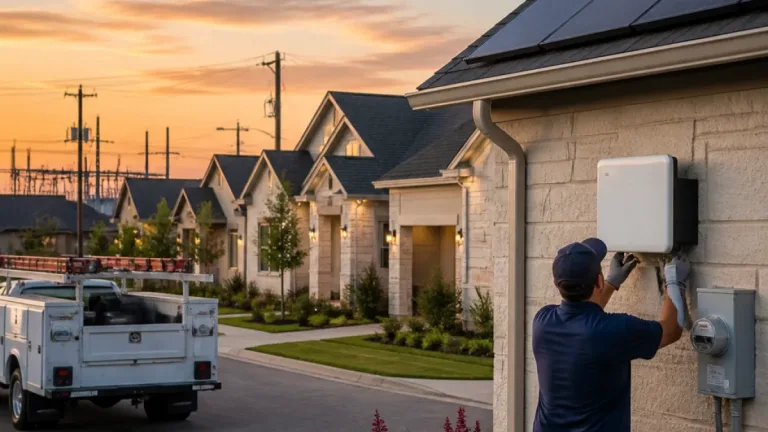

DTE Energy and sonnen have launched a two-year residential battery pilot at Veridian at County Farm in Ann Arbor, Michigan, creating a utility-coordinated test of home energy storage as a distributed grid resource. The program will connect nearly 100 homes in the mixed-income development, which contains 170 residences.
The pilot is designed to examine whether software-coordinated batteries in homes equipped with solar and storage can help DTE manage demand without relying solely on new centralized infrastructure. The October 29 launch follows approval from the Michigan Public Service Commission for an expedited pilot involving up to 100 participating customers.
Testing batteries as an aggregated resource
Rather than operating as one large battery installation, the program will combine the flexibility of individual household systems. DTE will study the amount of aggregate capacity available, the times at which customers participate and whether coordinated battery dispatch can assist during periods of high demand.
The development was created by Thrive Collaborative near Ann Arbor’s County Farm Park. DTE says Veridian spans 14 acres and includes all-electric equipment and rooftop solar. The pilot’s battery systems are sonnen home batteries, with the utility and manufacturer using the project to evaluate how a network of residential systems can operate as a virtual power plant.
- Location: Veridian at County Farm in Ann Arbor, Michigan
- Duration: Two years
- Scale: Nearly 100 homes connected within a 170-home development
- Regulatory approval: Up to 100 participating customers approved by the Michigan Public Service Commission
Regulator identifies evaluation areas
The commission’s September 10 decision in Case No. U-21653 identified enrollment, charging patterns, event participation and solar-battery optimization as areas for evaluation. The approval and the utility’s October launch are separate milestones in the program.
The pilot announcement does not publish a verified megawatt rating for the combined battery fleet. DTE and sonnen also have not published verified dispatch results, total enrolled battery capacity or savings attributable to the program. Those figures will be important measures of the project as its two-year evaluation proceeds.
Separating development size from battery capacity
Veridian’s 170-home total should not be treated as the size of the participating battery fleet. DTE describes the program as connecting nearly 100 homes, while the commission approved participation for up to 100 customers. The distinction leaves the project’s final enrollment and aggregate storage capacity subject to the pilot’s implementation and evaluation.
For residential technology professionals, the project brings together several installation categories in one utility program: home batteries, rooftop solar, all-electric equipment and software-based coordination. The published details center on the pilot’s testing objectives and regulatory framework rather than a finished performance result. DTE’s October 29 launch therefore establishes the program, while dispatch behavior, customer participation and measurable grid effects remain subjects of the evaluation.