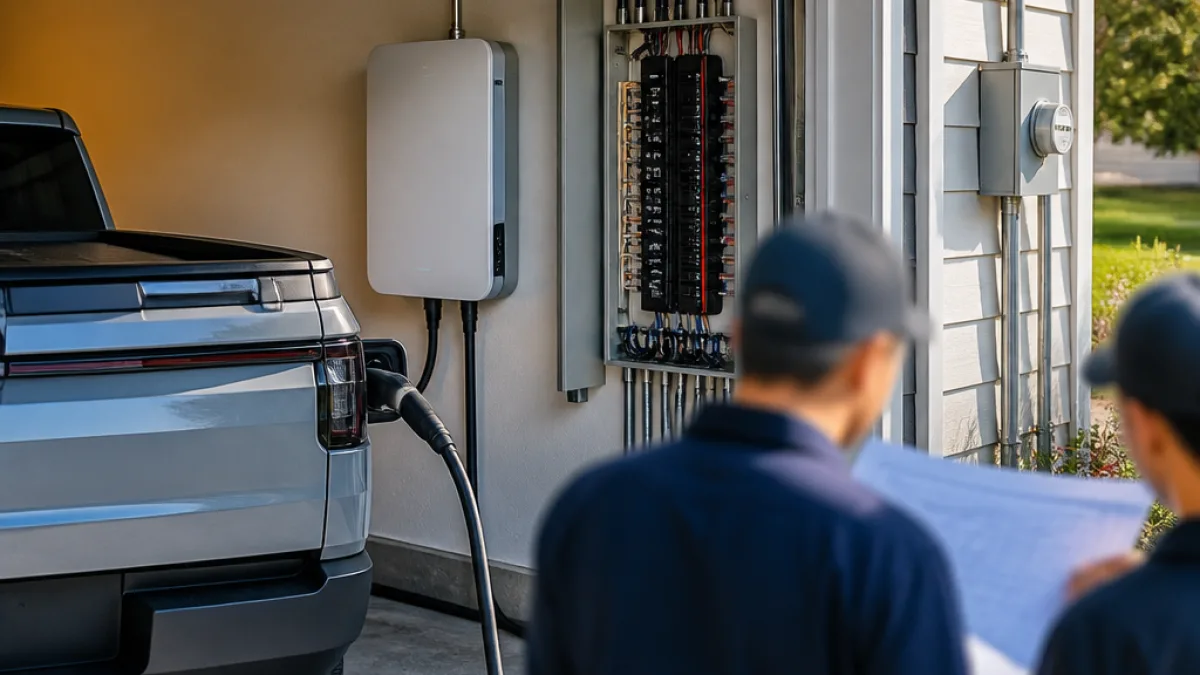
Ford has designed the Fathom’s electrical architecture to simplify bidirectional vehicle-to-home (V2H) and vehicle-to-grid workflows, reducing the external hardware burden installers previously needed to supply. The company says the vehicle’s charging module, one of five domain controllers inside the Fathom, replaces the need for an inverter-equipped wallbox used with earlier Ford trucks and allows the vehicle to supply AC power to a home when called upon.
What installers will need at the home
Ford says homeowners will still require two pieces of equipment to use the Fathom as a home battery: the Ford Home Power Station and the Ford Home Backup Panel. The manufacturer framed the Home Power Station as a lower-cost alternative to the inverter-capable wallbox previously required for the Lightning, and said it “should cost about half as much as the $1,310 device needed for the older, bigger truck.”
To enable whole-home backup during an outage, Ford says customers will additionally need the newer Home Backup Panel. The company expects that panel to be materially cheaper than its first-generation device, stating it “should cost 60 percent less than the first-generation panel, which cost around $5,000.” The new panel remains a required piece of the V2H installation to route vehicle power into a home’s electrical distribution.
Standards and grid pilots
Ford has taken steps to align the system with existing interconnection and safety norms. The company said the Fathom system meets the UL 1741 standard for chargers, the IEEE 1547 standard for connecting resources to the grid, and SAE J3068 for communications. Ford also reported it is working with utilities across the US and Canada on vehicle-to-grid pilot programs for the Fathom.
- In-vehicle charging module: one of five domain controllers; removes the need for an inverter-equipped wallbox used with earlier Ford EVs.
- Ford Home Power Station: required; Ford says it should cost about half as much as the $1,310 device used with the larger truck.
- Home Backup Panel: required for emergency backup; Ford says the newer panel should cost 60 percent less than the first-generation panel, which cost around $5,000.
Ford described the Fathom and its management software as capable of charging the vehicle when electricity prices are low and using vehicle energy to power the house when rates rise. The company also characterized the Fathom as the first bidirectional EV with AC power in its lineup, contrasting with previous approaches that required wallbox inverters.
| item | role | cost note (as reported) |
|---|---|---|
| Fathom charging module | Provides bidirectional charging capability in-vehicle | — |
| Ford Home Power Station | Required wall-side unit to use V2H with Fathom | “about half as much as the $1,310 device” |
| Home Backup Panel (new) | Required for emergency backup during outages | “should cost 60 percent less than the first-generation panel, which cost around $5,000” |
Ford further described the Fathom as a component in broader energy-management workflows, with software that schedules charging when electricity is cheaper and discharges to the home during expensive periods. The automaker said it is coordinating with utilities in the US and Canada to develop vehicle-to-grid pilots that would integrate Fathom-equipped vehicles into grid programs.
The company also pointed to compliance with interconnection and charger standards — UL 1741, IEEE 1547 and SAE J3068 — in describing the system’s readiness to operate in grid and utility programs.