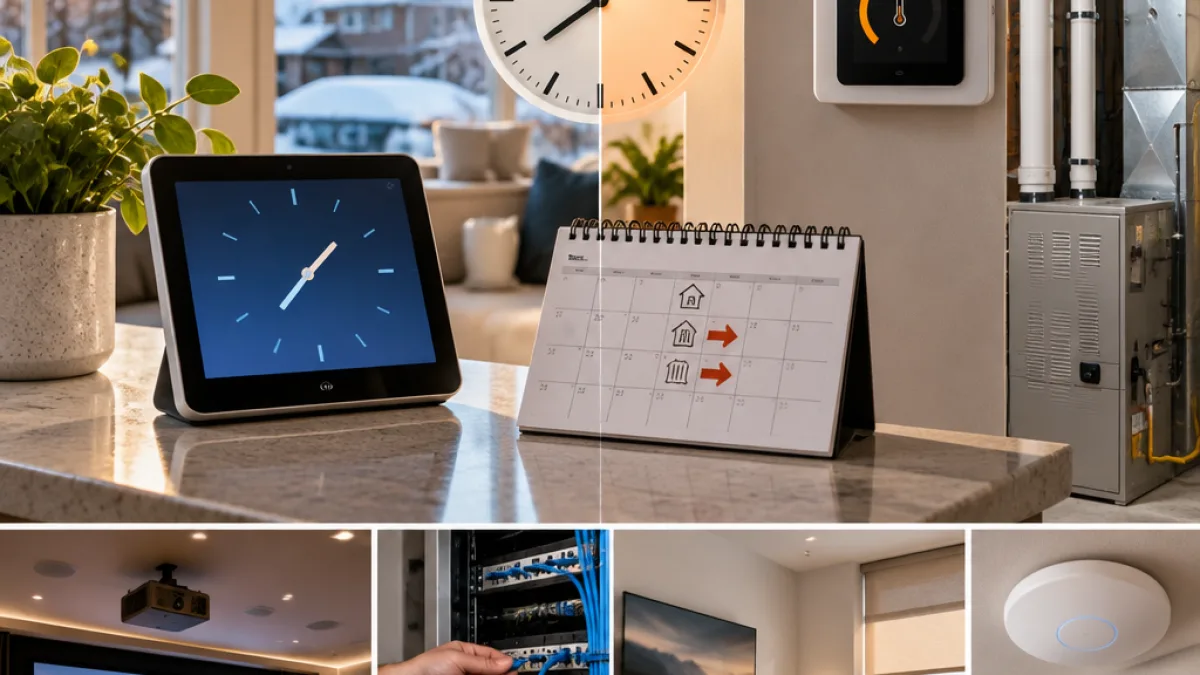
Google has acknowledged a daylight saving time issue affecting some Nest Hub displays and Nest Learning Thermostat devices in Canadian provinces where the seasonal clock change is not observed. The company said the problem affects a small subset of devices and that it is working on a fix.
The timing error emerged after daylight saving time ended on Sunday, November 1, 2026, at 2:00 am local time. In regions that do not change clocks, users reported that affected Nest products moved back by one hour even though local time had not changed.
Schedules shifted by one hour
The reported behavior extends beyond the time shown on a display. Nest Hub users said alarms were triggered at the wrong time, while Nest Learning Thermostat owners reported that programmed schedules and automations also shifted. That places the issue within the functions commonly used to coordinate daily routines and HVAC operation.
- Nest Hub clocks were reported to have moved back by one hour in areas that do not observe daylight saving time.
- Nest Learning Thermostat schedules and automations were reported to be offset by one hour.
- Users reported missed alarms and heating periods that did not begin at their expected times.
Reports cited by Android Authority came from several parts of Canada, including British Columbia, Alberta and Manitoba. Some users said the timing error made them late for work, while others reported waking up in homes that were colder than expected because thermostat programming had run at the wrong time.
“Google is aware of an issue affecting a small subset of devices in some provinces in Canada where daylight savings is no longer observed. We apologize for any inconvenience and are actively working on a fix.”
Google provided that statement to Android Authority on November 3 at 4:07 pm ET. The company’s response specifically identifies Nest devices in affected Canadian provinces and describes the problem as limited to a small subset of products. The statement does not characterize the issue as a general failure across all Nest devices or regions.
Relevance for installed systems
For dealers and integrators, the incident concerns the reliability of time-based behavior in connected thermostats and home-control routines. A one-hour offset can affect more than a clock display when a device is responsible for alarms, scheduled temperature changes or other automations. The reported symptoms also show why time-zone and seasonal-time settings remain operational details in residential technology deployments.
Google’s acknowledgment confirms that the company is investigating and developing a correction. Until that work is completed, the reported issue remains limited to the devices and Canadian locations identified in the company’s statement. No product recall, security incident or hardware replacement program was announced in the reported update.