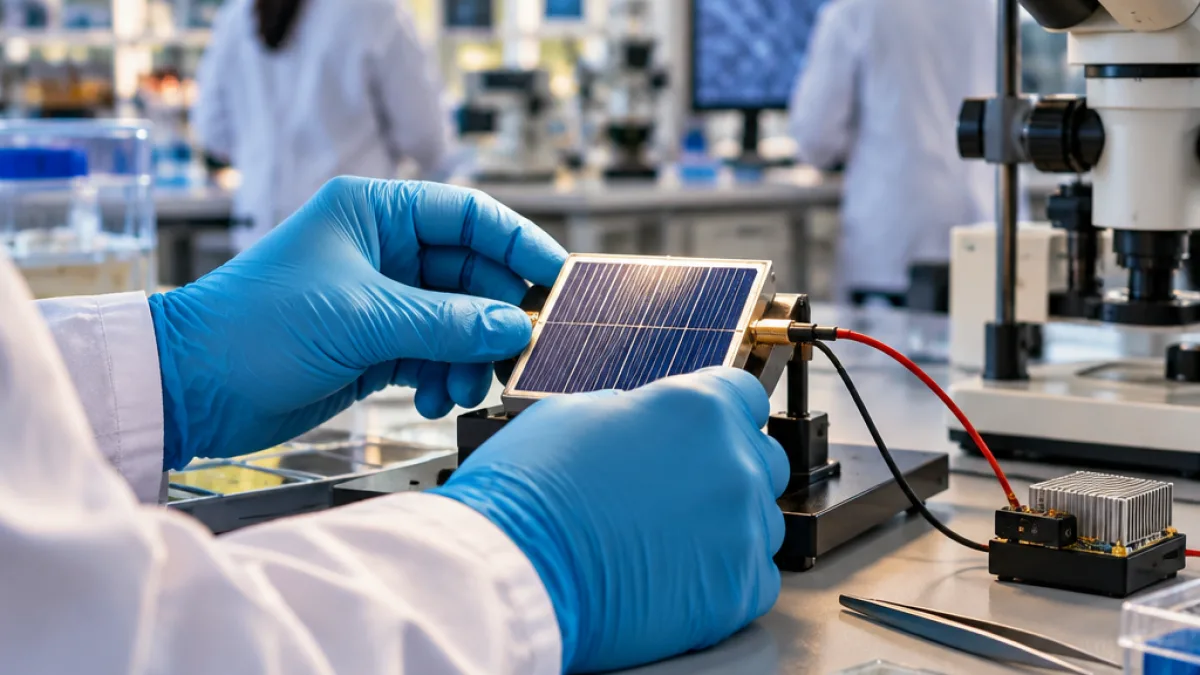
Researchers at Kaunas University of Technology (KTU) are investigating whether light already present in homes, offices and other interior spaces can provide power for small connected devices. The work centers on indoor photovoltaics, a class of solar technology designed to generate electricity from the relatively low-intensity artificial and natural light found inside buildings.
Indoor light is normally absorbed by walls, furniture and other surfaces rather than being used as an energy source. KTU’s Chemistry of Materials research group is examining ways to intercept part of that illumination before it is lost. The effort is directed at a problem with a direct connection to the expanding Internet of Things, where sensors, trackers, wearables and connected appliances all require a continuing source of power.
“The energy from indoor light sources and natural light entering through windows is lost every day.”
Professor Juozas Vidas Gražulevičius, who heads KTU’s Chemistry of Materials research group, described the loss in those terms. Unlike conventional photovoltaic systems, which are generally designed around outdoor sunlight, indoor photovoltaic devices must operate under weaker illumination from lamps, LED panels and daylight entering through windows.
Perovskite cells for indoor conditions
The KTU-developed material was used by researchers at Ming Chi University of Technology in Taiwan to build perovskite solar cells for indoor applications. The collaboration places the research within a developing area of photovoltaic engineering that targets electricity generation in environments where standard outdoor solar modules are not suited to the available light.
That distinction matters for connected-home equipment. Many sensors are distributed throughout buildings and may be difficult to access once installed. Batteries can provide the required power, but they eventually run down, need replacement and contribute to waste. A photovoltaic cell that draws energy from ambient illumination could provide a different approach for devices with modest power requirements.
- Research focus: photovoltaic generation under low-intensity indoor and window-supplied light
- Material direction: perovskite cells developed using KTU research
- Potential applications: IoT sensors, trackers, wearables and connected appliances
Relevance to connected buildings
Lighting is central to the concept because indoor photovoltaic systems depend on the illumination already delivered by a building. The technology is therefore being considered not as a replacement for room lighting, but as a way to recover a portion of the energy reaching interior surfaces and use it locally for small electronics.
Dr. Asta Dabulienė, a Senior Researcher at KTU, identified indoor perovskite photovoltaics as an opportunity for integration into connected devices. The research could be relevant to manufacturers developing sensors and other low-power hardware, as well as to professionals planning large numbers of distributed devices in residential and commercial environments.
KTU’s work remains at the research stage in the material provided. No commercial product, installation program, output rating or availability timetable is established. For the professional lighting and smart-home channel, the immediate significance is the direction of development: indoor illumination is being examined as a possible energy source for the sensors and controls that increasingly accompany connected spaces.
| Research element | Details reported |
|---|---|
| Institution | Kaunas University of Technology |
| Technology | Perovskite photovoltaic cells for indoor use |
| Collaborating researchers | Ming Chi University of Technology in Taiwan |
| Target environment | Low-intensity artificial light and natural light entering through windows |