The Korea Institute of Machinery and Materials (KIMM) has developed a smart lighting system that changes the perceived color of an object by controlling the light falling on it, rather than changing the object’s surface. The technology is designed to make a selected item appear in different colors while maintaining natural white illumination elsewhere in the room.
The development is relevant to lighting designers and integrators working with programmable architectural systems because it separates the appearance of a target object from the overall color of the space. Conventional color-tunable lighting can change the appearance of an entire area when the illumination spectrum is adjusted. KIMM’s approach instead uses precise control of light at multiple wavelengths to influence the light reflected from a particular object.
Controlling reflected light
Dr. Suwan Jeon, Senior Researcher at the Department of Nano Display Research of KIMM’s Nano Convergence Research Division, established the principles behind the color-control method, developed an LED lighting system and experimentally verified the resulting changes in perceived color.
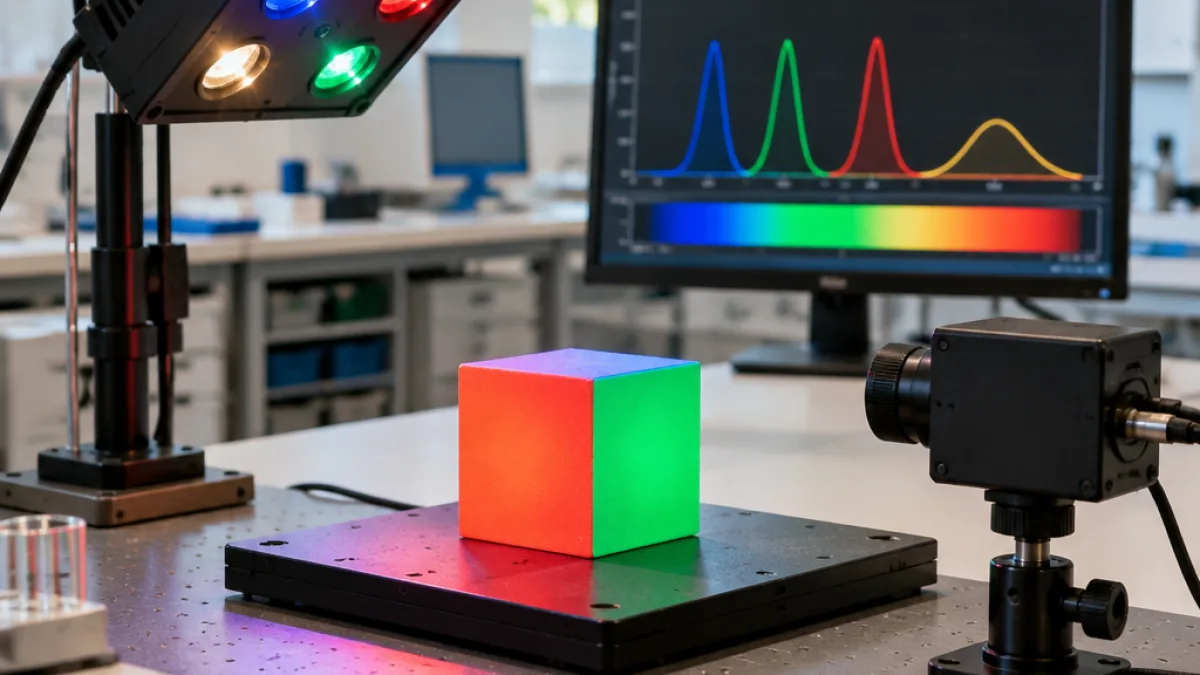
The system is based on the relationship between illumination and visual perception. An object’s apparent color depends on the light that strikes it and the light reflected toward the viewer’s eye. By adjusting the combination of wavelengths emitted by the lighting system, the KIMM team can change how that reflected light is perceived without attaching a device to the object or modifying its material.
“The same object can appear to have a different color when the incident light changes.”
KIMM said the system addresses the wider-space color shift associated with conventional approaches by controlling the brightness of multiple LEDs with greater precision. The intended result is a colored appearance on the selected object while the surrounding illumination remains natural white. That distinction could be significant in applications where exhibits, products or architectural features need dynamic visual treatment without turning the entire environment into a colored scene.
System development and validation
To assess the technology, Jeon developed a lighting system using several types of LEDs along with a measurement system. The work covered the color-control theory, the design of the LED lighting system and experimental validation of the changes in how objects appeared.
- Control method: adjustment of light at multiple wavelengths
- Target effect: change in the perceived color of a specific object
- Surrounding illumination: natural white light maintained outside the target area
- Object treatment: no repainting, surface modification or attached device required
KIMM said visitors would be able to observe the effect on the same object at an exhibition held at the National Science Museum in November. The demonstration is intended to show how one object can appear in different colors as the lighting conditions change.
The announcement describes a developed and experimentally verified lighting technology, rather than a commercial product launch. It does not identify a dealer program, installation channel, pricing or commercial availability. For professional lighting projects, the reported work therefore provides a demonstrated control approach rather than a specified product for immediate deployment.