Arista Networks has announced a new R4 router family for the front end of distributed artificial intelligence networks, targeting environments where inference traffic runs alongside storage, wide-area network links and legacy applications. The launch also includes a coherent transport router and a 25.6-Tbps pluggable optical line system.
The company is positioning the portfolio around distributed AI inferencing rather than the high-density back-end networks used for model training. Inference can be performed at multiple sites closer to users instead of in a small number of centralized facilities. Arista said that approach is gaining momentum as organizations address latency and data-sovereignty requirements, particularly in Europe and Asia-Pacific.
Routers aimed at the network edge
According to Brendan Gibbs, area vice president of product line management at Arista, the front end presents a different networking problem from an AI training cluster. In these deployments, routing, deep packet buffers and built-in encryption are needed because AI requests share the infrastructure with conventional enterprise workloads.
“A lot of our prior portfolio announcements have been the superlatives, like highest density, highest speeds,” Gibbs said.
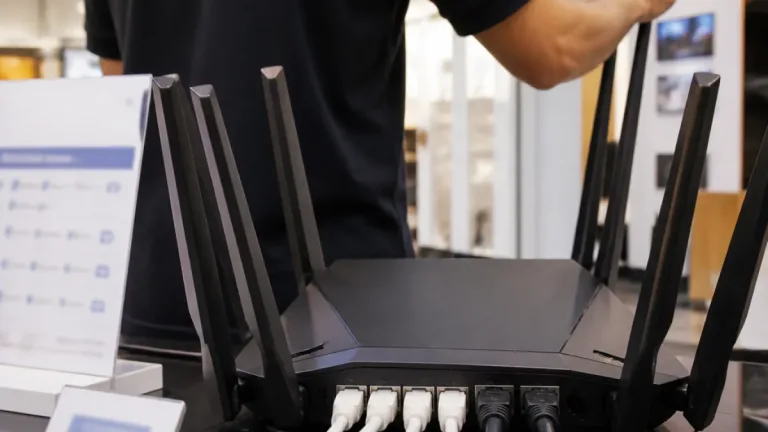
Arista’s new products move toward lower-speed aggregation for AI servers, with the company identifying 25-gig and 100-gig connectivity as the focus of this launch. The portfolio includes compact and hardened access routers, a coherent transport router and the optical line system for pluggable deployments.
| Product or category | Details announced by Arista |
|---|---|
| R4 router family | Routers for distributed, front-end AI inferencing |
| 7282R4 | Fixed router with two redundant supervisor modules |
| Optical line system | 25.6-Tbps pluggable system |
| Access portfolio | Compact and hardened routers, plus a coherent transport router |
The 7282R4 illustrates the shift from the company’s recent emphasis on back-end AI networking. It is a fixed, self-contained router with a set number of ports rather than a chassis designed for swappable cards. Arista said the model carries two redundant supervisor modules, which run the control plane.
Power and deployment claims
Arista claims that the new platform can use up to 60% less power than unnamed competing platforms based on older 7-nanometer and 16-nanometer chips. That comparison is a vendor claim and is not tied in the announcement to a named competitor or a specific workload.
The launch reflects a broader distinction between AI back-end and front-end networking. Back-end systems connect AI accelerators for a single training job and prioritize speed and density. Arista’s R4 products are intended for networks that bring inference closer to users while carrying a wider mixture of enterprise traffic. The company has announced the family for enterprise and service-provider use; the launch information identifies the products and capabilities but does not provide an MSRP or shipping date.