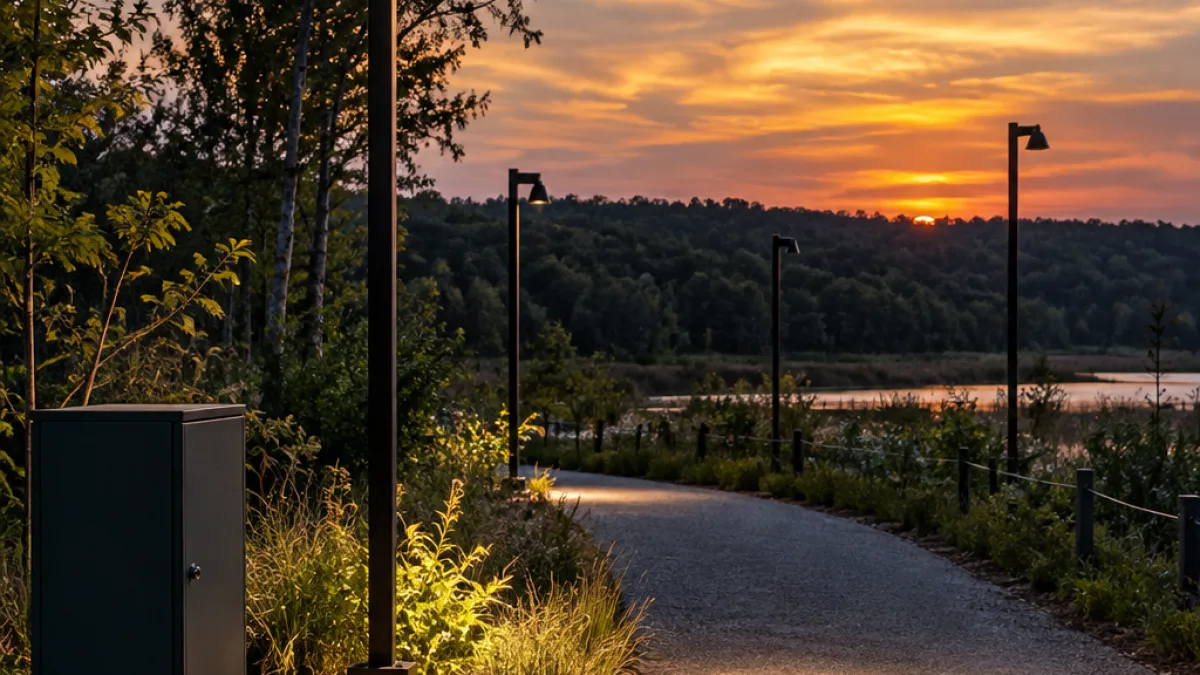
A scientific review published in Nature Reviews Biodiversity is challenging the way wildlife-friendly outdoor lighting is commonly specified. Rather than treating color temperature as the primary design decision, the paper places it at the bottom of a four-part hierarchy that begins with whether a light is needed at all and continues through distribution, output and operating time.
The review was written by six researchers led by Ashton Dickerson of the Leibniz Institute of Freshwater Ecology and Inland Fisheries in Berlin. Travis Longcore of UCLA is also among the authors. The researchers assessed existing studies rather than conducting new field research, and they acknowledge that the proposed order still requires testing across a wider range of species and environments.
A four-level approach to ecological light pollution
For installers, the hierarchy shifts attention toward decisions that can be made during the design and programming stages of an outdoor lighting project. The authors rank the measures in this order:
- Remove lighting that has no meaningful purpose.
- Restrict and reduce illumination using shielding, tailored optics and dimming.
- Reduce operating hours with time switches, motion sensing and smart controls.
- Adjust the spectrum to address sensitivity to particular wavelengths.
The review describes spectral tuning as a “supplementary measure.” The authors say warmer sources can reduce exposure for species affected by blue and ultraviolet light, but argue that color selection alone cannot provide a universal solution. Their conclusion is that there is “no universally ‘safe’ spectrum,” because a wavelength range that is less disruptive for one animal may still produce a response in another.
That finding places greater weight on the physical and control characteristics of a lighting system. The paper says shielding, optics and dimming should be considered together. Optical distribution, fixture output, mounting geometry and luminaire spacing all influence how much light reaches surrounding areas, meaning that a warm-white or amber source does not remove the need for careful aiming and intensity management.
Evidence for removal and shielding
The largest reported reductions came from eliminating lights that were not serving a real need. The researchers cite decreases of more than 90% in harm to insects and other arthropods when unnecessary lighting was removed. For manufacturers and integrators, the shielding result offers a separate design reference: at the same illuminance, shielded luminaires reduced insect attraction by approximately 50%.
That shielding evidence came from German towns and cities near nature reserves where shielded luminaires had been installed. The result does not establish a universal performance level for every fixture or site, but it supports treating cutoff, optics and placement as central parts of an ecological lighting specification rather than as secondary details after color temperature has been selected.
Operating schedules provide another control point. The review identifies time switches, motion sensing and smart controls as methods for limiting the hours during which outdoor illumination is active. In a professionally integrated system, those functions can be considered alongside fixture selection and dimming behavior, while the paper’s hierarchy keeps them distinct from spectrum selection.
Implications for product claims and system design
The authors’ position complicates product claims based primarily on amber or warm-white LEDs. Warm light remains part of the proposed approach, particularly for species sensitive to blue and ultraviolet radiation, but the review ranks it behind removal, shielding, optical control, dimming and time management. The paper therefore points toward a broader definition of wildlife-conscious lighting—one that includes the complete installed system rather than a single LED characteristic.
For the custom channel, the practical message is one of coordination: fixture choice, optical distribution, mounting position, dimming levels and control schedules should be evaluated as connected elements. The researchers caution that the hierarchy needs further testing across species and settings, so its recommendations are presented as a framework for reducing ecological light pollution rather than as a universal certification standard.