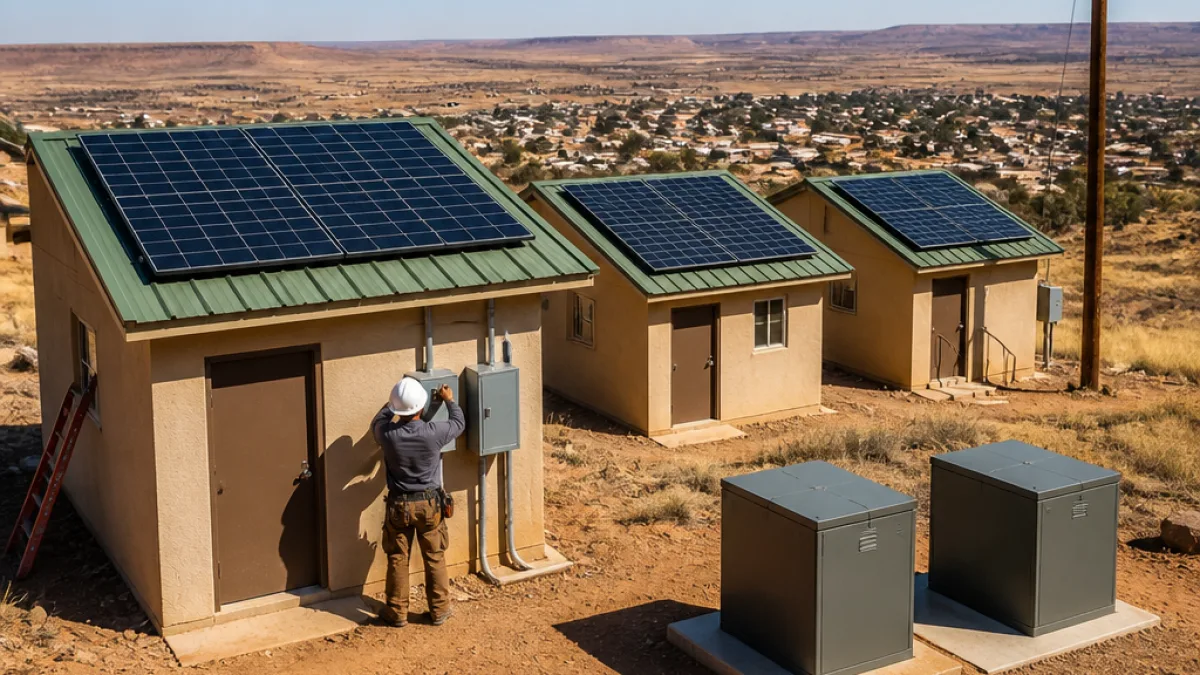
The Mesa Grande Band of Diegueño Mission Indians has completed its first public clean-energy project: a solar-plus-storage installation that will power three tribal administration buildings and provide resilience during frequent outages on the rural San Diego County reservation.
“According to Solar Power World , the reservation's first public clean-energy project is complete.”
Project scope and expected benefits
The systems were installed at the Tekamuk, Hallyeyaaw and Golden Eagle administration buildings. The combined installations are projected to produce about 60 megawatt-hours of energy annually. Mesa Grande expects the project will lower electricity costs for those facilities by at least $16,780 each year.
- Sites served: Tekamuk, Hallyeyaaw, Golden Eagle administration buildings
- Annual production: about 60 MWh
- Projected annual savings: at least $16,780
- Primary benefit: continued operation of tribal government and community services during outages
Resilience and local context
With battery storage paired to the solar arrays, the three administration buildings can remain operational during the frequent local outages that affect the reservation. The facilities support tribal government work, housing assistance, educational and cultural programs, and food and emergency-response services for residents—functions Mesa Grande highlights as essential to keep running when the grid goes down.
Installation approach and background
The project was delivered through a partnership between the Mesa Grande Band of Diegueño Mission Indians and the Solar Electric Light Fund. Systems were sized around the existing demand of each building and include capacity for future expansion. The installation continues more than two decades of the tribe’s clean-energy efforts, which include previous home solar projects, renewable-power planning and solar-related workforce training.
| building | role |
|---|---|
| Tekamuk | administration building |
| Hallyeyaaw | administration building |
| Golden Eagle | administration building |
Mesa Grande notes the reservation first received electric service in the 1950s, yet some households remain off-grid and rely on small generators. The new project aims to strengthen energy sovereignty where dependable power affects essential day-to-day services, and to reduce reliance on backup generators for critical tribal operations.
The installation also provides a local example of how combining solar with battery storage can support community resilience and operational continuity for public facilities in areas prone to extended outages.