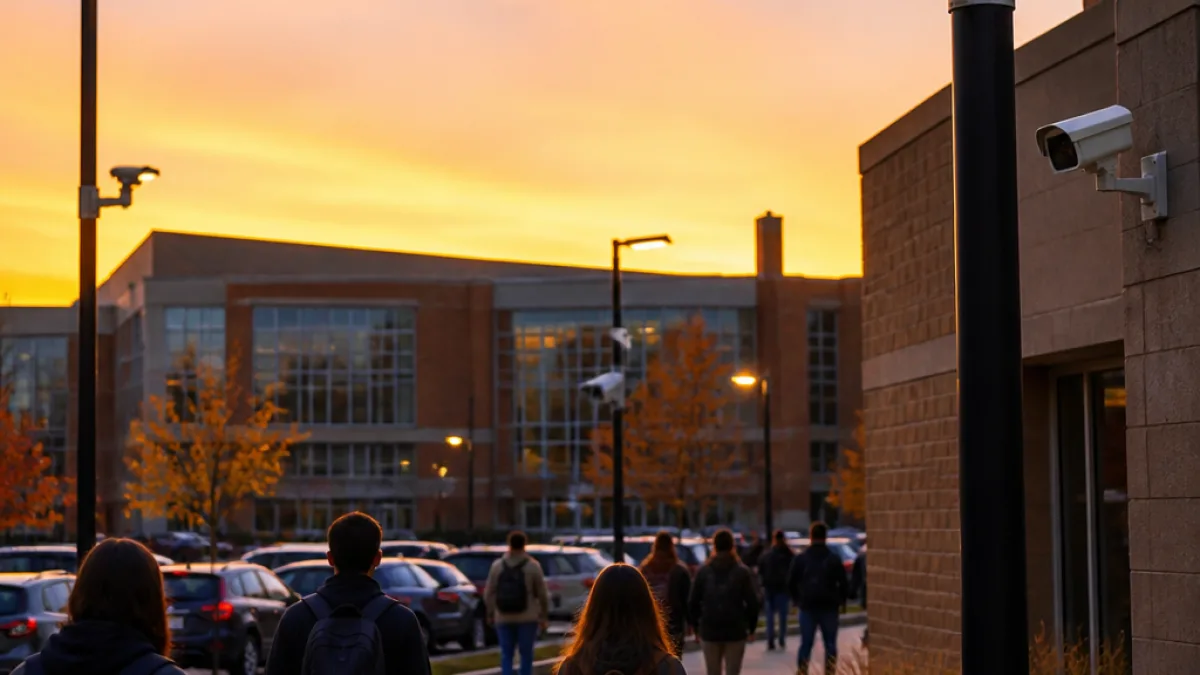
Local reporting has documented more than 55 Flock Safety automated license plate readers (ALPRs) in Kalamazoo, with six of those cameras located within one mile of Western Michigan University’s main campus. The cameras, commonly called Flock cameras, scan vehicle license plates and upload data into searchable databases that are monitored by police departments, according to the report.
What the cameras do and how they are used
Flock Safety’s systems employ artificial intelligence to detect and read license plates from vehicle scans and then index those records for investigative use. Police departments use the databases to help locate stolen cars, track missing vehicles and assist other law-enforcement activities. The cameras are sited on public streets and at key traffic points; the reported installations in Kalamazoo include units positioned near major ramps and thoroughfares.
“Just driving around Kalamazoo, I’ve seen them everywhere,” said WMU sophomore Madeline McDonald.
Students interviewed by the outlet expressed that the presence of the cameras felt intrusive and raised concerns about privacy and surveillance. One student described the cameras as making them feel “very unsafe, like the opposite of what they think that they’re doing.” Another said the cameras represented “an invasion of privacy.”
Reported risks and incidents
The Institute for Justice (IJ) database, cited in the reporting, lists more than 100 alleged incidents of ALPR abuse. The database records a range of reported outcomes, including wrongful stops and detentions, stalking incidents and cases tied to tracking of patients seeking abortion care. The local reporting also referenced multiple reports of wrongful arrests attributed to misreads of license-plate numbers by ALPR systems.
- Documented cameras: more than 55 in Kalamazoo, six within one mile of campus
- Technology: AI-based plate detection and indexing into searchable databases
- Reported incidents: IJ database logs over 100 alleged abuses, including wrongful stops and stalking
Students questioned the reliability of AI-based plate reads and contrasted it with human discretion. One student said that automated systems may lack the contextual judgment that a police officer could exercise on scene.
Implications for integrators and planners
Municipal ALPR deployments combine camera placement, network connectivity, backend storage and law-enforcement access policies. Installers and integrators working on institutional or city surveillance projects should note that public and community reactions can be significant when ALPR systems are deployed in residential or campus-adjacent locations. The reporting ties community unease to both the density of cameras and documented cases of alleged misuse recorded in civil-liberties databases.
| Item | Detail |
|---|---|
| Number of cameras documented | More than 55 in Kalamazoo; six within one mile of WMU main campus |
| Primary function | Automated license-plate recognition and indexing into searchable databases |
| Cited civil-liberties data | Institute for Justice database: over 100 alleged ALPR abuse incidents |
The local coverage records students’ perspectives and references documented incidents; it does not, however, supply technical deployment specifications, contract terms between Flock Safety and local governments, or detailed operational policies for law-enforcement access to the ALPR data. The reporting quoted students and referenced the IJ database as the source for the number of alleged abuses.
For agencies and integrators, public documentation of camera counts and incidents underscores the importance of transparent policies, clear data-retention rules and community engagement when installing or operating ALPR networks near campuses or residential areas.